How to split a shared bill fairly among friends
2026-11-07
Rounding each share to a unit, who covers the remainder when the total does not divide evenly, and what to check before sending money.
Why group bills are awkward
Meals, trips and gifts shared by several people are often paid up front by one person. When the total does not divide neatly, working out who owes what becomes tedious. A split bill calculator makes the sums quick and fair.
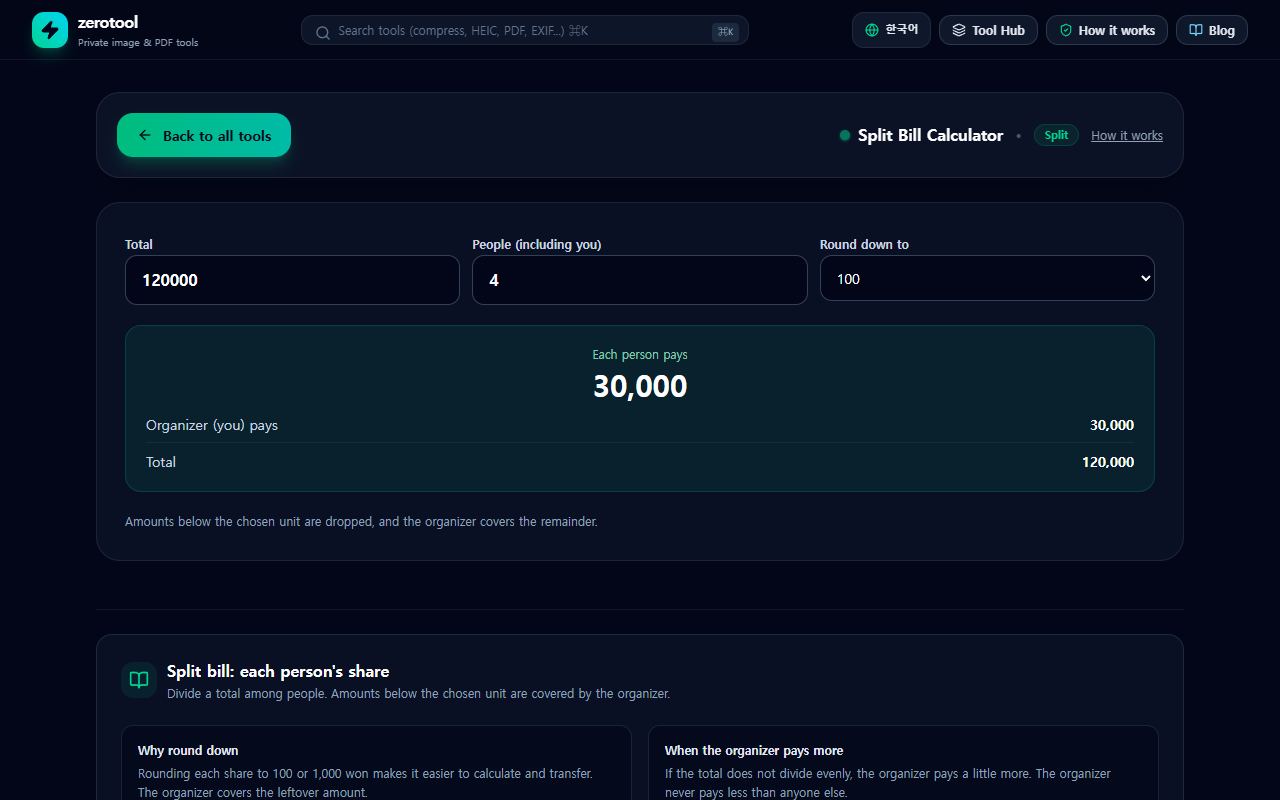
The basic sum: total ÷ people
Divide the total by the number of people who took part. For example, 120,000 won shared by four people is 30,000 won each. That is easy when the numbers divide evenly. The trouble starts when they do not, for example 40,000 won between three people.
Rounding to a unit
Sending exact amounts down to the won is awkward. It is common to round each share to 100 won or 1,000 won. The fraction below the unit is dropped. For example, 10,000 won split three ways is 3,333.33 won each, and rounded to 100 won each person pays 3,300 won.
The organizer covers the remainder
When everyone else pays the rounded share, the organizer pays whatever is left. In the example above, the two other people pay 3,300 won each, and the organizer pays the rest, 3,400 won. The organizer pays a little more, but never less than anyone else. That rule keeps the split fair.
The steps
1. Confirm the total paid. Check that it matches the receipt.
2. Enter the number of people. Include yourself if you are the one collecting the money.
3. Choose a unit. A 100-won unit is usually enough, and 1,000 won works for larger bills.
4. Check the share and the organizer’s amount, then tell everyone.
Before you send money
- Check the total against the receipt once more.
- Make sure the amount reflects any discount or coupon that was applied.
- Separate items that should be split differently, such as personal orders or drinks.
- Add a short note to each transfer saying what it is for, so nobody gets confused later.
Tips for repeated gatherings
If you meet regularly, record who paid each time and who has been paid back. Taking turns to pay makes the arithmetic much simpler. For small amounts, you can also net the balances off against the next gathering.