How savings interest is calculated and how much tax is taken
2026-11-07
The difference between simple and monthly compound interest, how the 15.4 percent interest tax applies, and how to work out a monthly target.
What to work out before opening a savings plan
A savings plan has you deposit a fixed amount every month and receive the principal plus interest at maturity. The same amount at the same rate can produce different maturity figures depending on how interest is added and how much tax is taken. Estimating the payout before you sign up makes it easier to set a realistic goal.
Simple interest and monthly compounding
Many instalment savings products use simple interest. Each deposit earns interest only for the months it stays in the account. The first deposit earns for the longest period, and the last one earns for a single month.
Monthly compounding adds the interest to the balance each month, and the next month’s interest is calculated on the larger total. Interest on interest makes the result slightly higher under the same conditions. The gap grows with a longer term and a higher rate. Check the product terms to see which method a given product uses.
The 15.4 percent interest tax
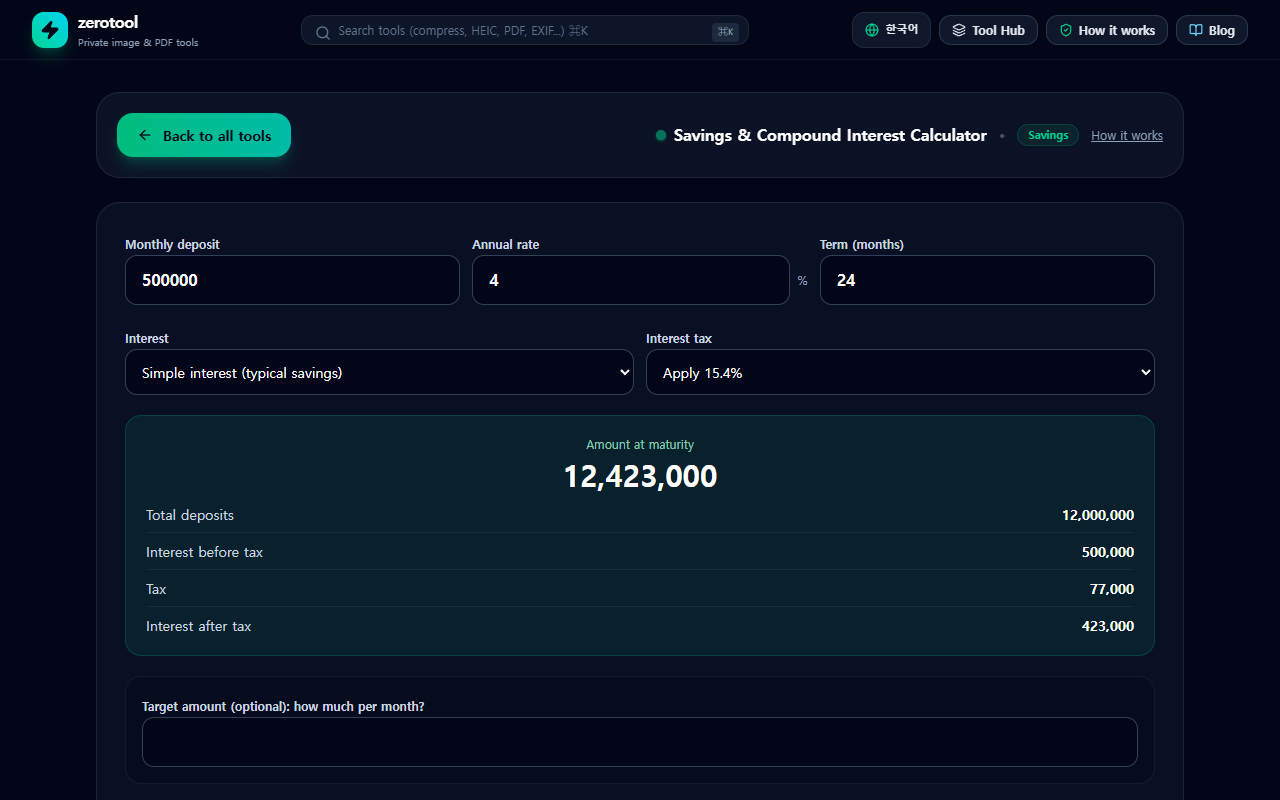
Interest is taxed. The total of 15.4 percent is made up of 14 percent income tax and 1.4 percent local income tax. For example, if the pre-tax interest is 500,000 won, the tax is 77,000 won and the interest after tax is 423,000 won. Turn tax off in the calculator to see the pre-tax figures.
A worked example: 500,000 won a month, 4 percent a year, 24 months
Depositing 500,000 won for 24 months means 12 million won of principal. With simple interest, the pre-tax interest is about 500,000 won, and after tax about 423,000 won remains. The maturity amount is roughly 12.42 million won. Monthly compounding under the same conditions comes out slightly higher.
How much do you need to save each month?
Enter a target amount in the calculator and it works backwards: for the same rate and term, it shows the monthly deposit needed to reach the goal. For example, if you need 10 million won in two years, you can see at a glance how much to put in each month. This figure uses monthly compounding and does not include tax.
Things to check
- The rate on a product is often a base rate plus bonus rates. If you do not meet the bonus conditions, a lower rate applies.
- Early cancellation usually earns a lower rate, so choose an amount you can keep until maturity.
- Tax-free or tax-preferred products need their own calculation. This calculator assumes ordinary interest tax.