Equal payment vs. equal principal: which loan repayment costs less
2026-11-07
How the monthly payment and total interest differ between the two repayment methods, with the formulas and worked examples.
What to settle before taking a loan
A long-term loan, such as a mortgage, forces you to choose a repayment method. There are two main options. Equal payment means you pay the same amount every month. Equal principal means you repay the same share of the loan each month, so the payments shrink over time. The two methods give different monthly burdens and different total interest.
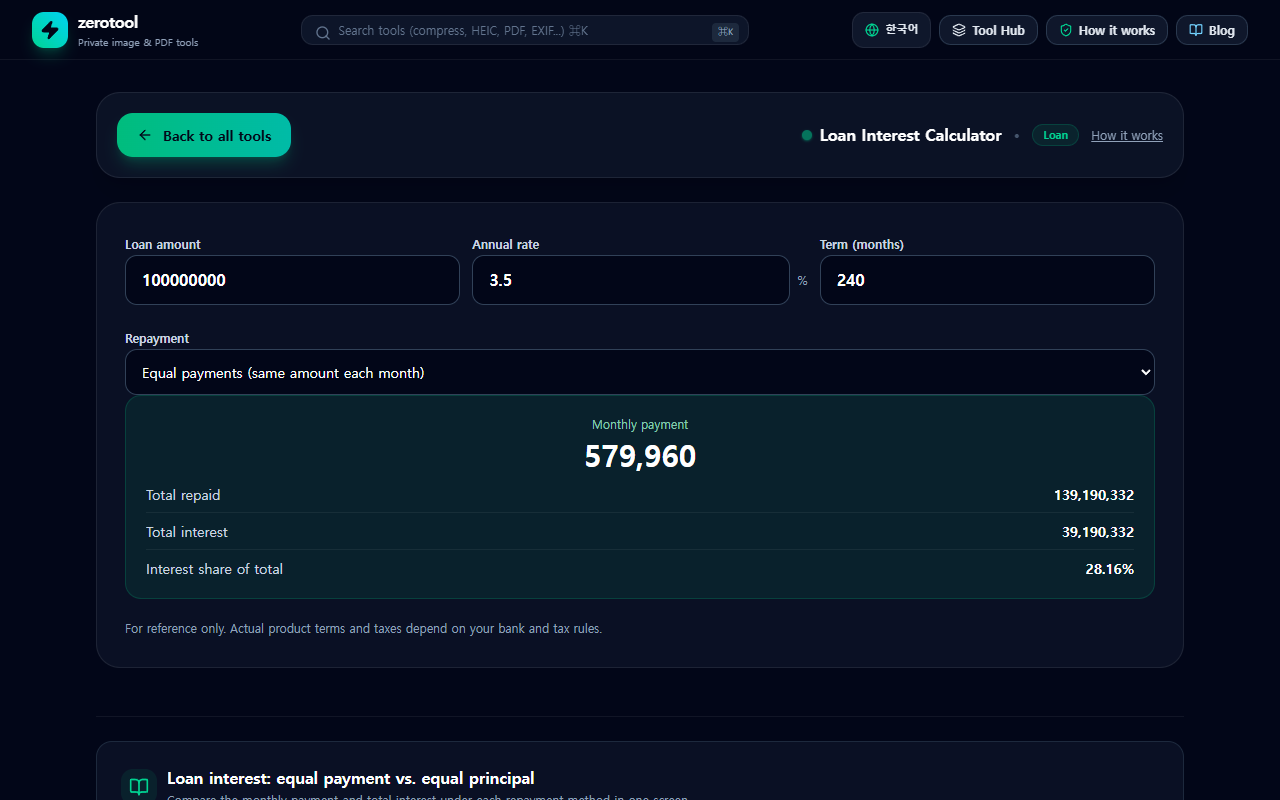
Equal payment: the same amount each month
Because the monthly amount never changes, it is easy to plan a budget around it. The early years are not especially heavy. In return, more of each early payment goes to interest, the principal falls slowly, and the total interest is higher than with equal principal.
The formula uses r, the monthly rate, and n, the number of months. The monthly payment is the loan amount × r × (1 + r)ⁿ ÷ ((1 + r)ⁿ − 1).
Equal principal: highest at first, then falling
You repay a fixed slice of the principal each month and add the interest on what is still owed. Because the balance falls, the interest falls too. The first payment is the largest and each later payment is smaller. The total interest is lower than with equal payment.
A worked comparison
Take a loan of 100 million won at 3.5 percent a year over 20 years, which is 240 months. An equal-payment loan costs roughly 580,000 won a month. An equal-principal loan starts at about 710,000 won in the first month and falls from there. The total interest is lower with equal principal. Enter your own numbers in the calculator to see the exact figures.
Which one fits your situation?
- If you need a steady monthly budget, equal payment is easier to live with.
- If you have room in the early years and want to pay less interest overall, equal principal is cheaper.
- If your income is expected to rise, check whether the higher early payments of equal principal are still manageable.
Limits of the calculator
- It assumes the rate you enter stays the same for the whole term. A variable-rate loan will change the payments.
- Early repayment fees, stamp duty and guarantee fees are not included.
- Confirm the real terms with the lender’s product explanation before you sign.